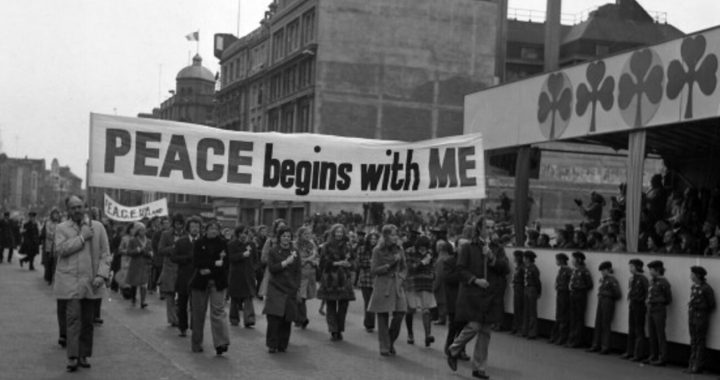
It would still be St. Patrick’s Day, but the idea was to turn it into something else as well.
This was the early 1970s and at a Cabinet meeting of the recently created Fine Gael-Labour coalition government, held on 10 July 1973, it was decided that the following March 17th would be designated as a day with a difference.
Yes, St. Patrick’s Day would be celebrated in the usual ways; however, it would now also double as a day of ‘national commemoration and reconciliation’.
Or would it?
When the first public announcement of what was being proposed was made later that same summer, it emerged that the words ‘and Reconciliation’ had been quietly dropped.
The reason for their removal, a Department of Taoiseach official explained, was that it lent an impression that Irish people had an endless ‘history of being at loggerheads’, and that, whatever about the prevailing violent reality, there might be a time in the future when this was no longer the case, and when the people who shared this island might not actually be in need of reconciliation.
Yet the whole impetus behind the original inclusion of ‘reconciliation’ – whatever that might mean or entail – in the St. Patrick’s Day plan had been a growing despair at the escalating violence of the northern ‘Troubles’, and the increasing polarisation that was resulting.
In the eighteen months prior to the Government making its decision, the north had spiralled ever deeper into chaos and disorder – almost 500 people, over half of them civilians, had been killed in 1972 alone in what would turn out to be the worst year of the Troubles.
Against this backdrop, an Irish government event focussed on reconciliation might do little to reconcile anyone, but it might help lower the political temperature. It might, in some slight symbolic way, help elevate voices of restraint, of moderation. And that, even if the word ‘reconciliation’ wasn’t front and centre, was at least part of the calculus in official thinking when it came to organising St. Patrick’s Day, 1974.
To help with that organisation, on the suggestion of Conor Cruise O’Brien, then Minister for Posts & Telegraphs and original source of the commemorative plan, a small interdepartmental committee was established on which O’Brien’s own adviser and son-in-law, Nicholas Simms, sat.
The Committee’s proposals were modest.
There would be no showy displays. Pomp and major ceremonial were considered best avoided. A military parade was, consequently, ruled out. As was any event centring on the still recently developed Garden of Remembrance – Cruise O’Brien, for his part, had already expressed the view that doing so would deprive the ‘new commemorative concept of any unifying value it might have in relation to the North.’
Instead, what the committee proposed was a commemoration involving three distinct elements: the inclusion in regular St. Patrick’s Day church services of a special prayer emphasising the pursuit of peace, followed by a silence for ‘all who lost their lives as a result of war or civil strife’; a broadcast address on television and radio by the President of Ireland, Erskine Childers; and a state reception, to be held on the evening of March 17th.
Just who would attend that state reception was unclear.
Given the political temperature of the times, inviting guests from the north required, it was acknowledged, ‘careful consideration’.
Many from a unionist background who the government might want to attend would, it was well known, not welcome an invite. Indeed, officials raised the matter with Northern Ireland’s top civil servant, Ken Bloomfield, stressing the government’s reluctance to issue invitations that might cause embarrassment. A note to Taoiseach Liam Cosgrave ultimately advised pulling the plug on the state reception on the basis that it had been originally conceived on a ‘reconciliation theme’ that had not been publicly advertised.
Even so, complications remained.
Irish officials were still wary, for instance, of the words to be used in both the Church prayers and the President’s broadcast address, lest they have an effect opposite to what the day was intended to achieve.
Even references to ‘reconciliation’ came freighted with difficulty, as one official noted that it was then ‘taken by many in the North as equivalent to “reunification”’.
This guarded, hesitant approach extended into a reticence to publicise the commemoration too far in advance.
In early March 1974, a fortnight before St. Patrick’s Day, one Sunday newspaper ran an article which wondered whether the ‘whole project has been quietly abandoned’.
It hadn’t.
The commemoration went ahead as planned, though it served less as a day of remembrance than a platform for promoting peace. Everywhere, and from almost everyone, peace was the core message enunciated – it had acquired an added urgency with the killing by the IRA of Senator Billy Fox in Co. Monaghan (the only member of the Oireachtas killed during ‘the Troubles)’ the week before.
Hardly surprising, then, that in their St. Patrick’s prayers and homilies, religious leaders spoke of the need for an end to violence, as did Erskine Childers.
In his RTÉ broadcast, the President declared it a tragedy that Irishmen were ‘pursuing a course which is leading daily to their own destruction and adding to the toll of death and injury of innocent persons.’ Furthermore, he urged that the ‘best memorials to our dead and solace to our injured are peace with justice and progress towards mutual trust, understanding and tolerance of differing traditions and aspirations.’
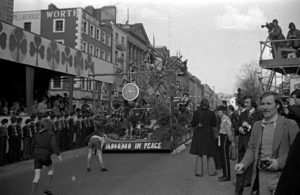
St. Patrick’s Day Parade, Dublin, 1974 (Dublin City Library and Archive)
However, President Childers’ did not confine his St. Patrick’s Day contribution to the airwaves. He also attended, alongside his predecessor, Eamon de Valera, an ecumenical Church service at Christ Church on Leeson Park, which formed part of civic society-led ‘Peace week’ initiative.
The purpose of ‘Peace Week’ was entirely in keeping with spirit of the government’s commemoration, and the participation of the President was indicative of their commonality of purpose. So, too, was the presence of several government ministers among the 2,000 people who marched in silent procession from the GPO to St. Patrick’s Cathedral, carrying with them almost 1,000 white crosses to represent each of the lives up to then lost in the ‘Troubles’.
Yet if there was no doubting the seriousness of the cause, it was all, ultimately, to little effect. It was, as an Irish Times editorial noted, a ‘bitter irony that Peace Week ’74 should have seen some of the worst crimes of recent years’.
Moreover, in the weeks and months that followed, bombs would be exploded in Dublin and Monaghan (killing 33 people and injuring hundreds more), while the success of loyalist militancy in collapsing the power-sharing executive established under the Sunningdale Agreement, created a political vacuum in the north that only deepened the despair that had given rise to all the peace talk in the first place.
As for the idea of National Day of Commemoration, a later Department of Taoiseach memorandum conceded that it had ‘no particular impact’ and was ‘sunk without trace thereafter’.
St. Patrick’s Day had perhaps not been the most suitable of dates – it already had its own fixed and celebratory character – but there was also an acceptance that government could not simply ‘orchestrate’ the public response it clearly wished for the commemoration.
Acceptance would be hard won.
In the end, and not without considerable political difficulties, it would take until 1986 before a National Day of Commemoration would find its place in the Irish calendar, when it was held at the Garden of Remembrance on the Sunday nearest to July 11th, the date on which the truce in the War of Independence had been called in 1921.
It has been held at various venues every year since, and now, approaching its fortieth year, it routinely brings together representatives from north and south, and from all shades of political opinion and religious belief.