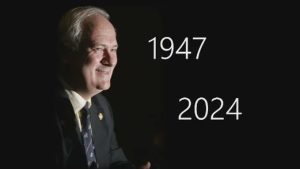
This week marks the first anniversary of the death of the former Taoiseach, John Bruton.
In the deluge of commentary and obituary profiles that accompanied his passing last year, you would have struggled to find any reference at all to sport.
Hardly surprising, really. It wasn’t exactly a career-defining issue for Bruton and he never evinced a great public passion for it.
He was certainly no Jack Lynch, a predecessor as Taoiseach who came to politics with pockets bulging with All-Ireland medals and a sporting profile that ensured instant national recognition. Nor was he a Bertie Ahern, another predecessor, whose popular man of the people image was cleverly cultivated by his conspicuous – and to be fair, sincere – support for the Dublin GAA teams and, of course, Manchester United.
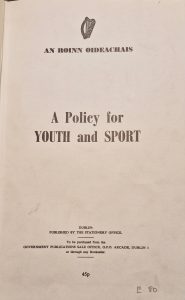
And yet, notwithstanding such comparisons, John Bruton might lay justifiable claim to being among the more consequential political figures in terms of influence on the development of Irish sport. The competition, admittedly, is not stiff, but it would be ungenerous to Bruton – whatever one’s views on his politics or perspectives on history – not to acknowledge his contribution towards the publication of a first-ever Government policy paper on youth and sport.
That was in 1977, when he was serving as a young parliamentary secretary in the Department of Education. This was a junior ministerial office which carried responsibility for sport and its establishment in 1969 coincided with the first direct State funding to Irish sporting bodies.
On that occasion, a sum of £100,000 was thinly distributed across sporting governing bodies and youth organisations.
It was of course a pittance and didn’t come remotely close to meeting the pent-up social and sporting demand.
But it was a start, and the spread of the funding underscored the diversity of an Irish sporting experience so often defined by the dominant codes of gaelic games, rugby and soccer.
In that first State allocation, for instance, £3,000 was awarded to the Association of Adventure Sports and £600 to the Irish Deaf Sports Association. In addition, badminton and basketball benefited from grants of £750 each, canoeing received £2,200 and gymnastics £500. The lowest allocations to sporting organisations were £100, with associations representing Irish Karate and amateur Weightlifting among the beneficiaries.
RTÉ News Report on the death of former Taoiseach, John Bruton
If the grants given were intentionally small, an important principle had still been established. Sport would continue to rely on voluntary organisations for its developmental impetus, but the provision of direct funding to sporting bodies suggested that the days of instinctive non-interventionism on the part of the State were at an end.
There were other pointers, too, of a step-change in official thinking: the establishment of a Sport Section within the Department of Education, the affording of greater recognition to physical education in school curriculums, and the launch of a National Council for Sport and Physical Recreation (Cosac), which acted as a short-lived advisory body to the Parliamentary Secretary on sporting matters.
All these developments took place under John Bruton’s predecessors, but when he assumed the Parliamentary Secretary role in the Fine Gael-Labour coalition government that was formed in 1973, there still no coherent sports policy to speak of.
In bringing one about, the Meath TD, still in his twenties at the time, proved himself to be a determined operator.
He had to be. His White Paper on Youth and Sport policy was prepared by February 1975, but took over two years to see the public light of day. In the interim, Bruton was met with a frustrating mix of ennui and opposition from government colleagues and their officials.
The policy itself ran to 107 pages and its sporting components embraced a ‘Sport for All’ concept that had gained significant ground throughout Europe; it’s principal purpose was to increase substantially the numbers participating in active sport.
Why? Because physical activity was understood to be an effective preventive medicine, benefiting people’s health and well-being, while helping to reduce the risks of juvenile delinquency.
For John Bruton, a critical part of the policy was the creation of a new Sports Council to replace Cosac, which had been let lapse owing to what he felt were deficiencies in its structure and its absence of clear objectives or obvious benefits.
A Sports Council with a more clear-eyed purpose, with its own secretariat and enhanced responsibilities, would go some way to bringing co-ordination to a system where the remits of multiple government departments and state agencies touched upon, however tangentially, sporting concerns.
Even so, when circulated for comment among his Cabinet colleagues, none rushed to slap Bruton’s back for his draft policy.
Some Ministers offered no observations at all. Others simply sought places for their own officials on the proposed Sports Council. For its part, the Department of Lands wanted it to be known that were already in the business of providing sites for sports fields and playgrounds. However, the most critical response came the Department of Finance which felt that, however desirable the proposals, the coffers couldn’t spare the finance necessary.
Still, Bruton kept at it.
With no improvement in the budgetary situation, and no progress made on publishing his policy, he eventually took to appealing to the political instincts of the Taoiseach, Liam Cosgrave.
In early 1977, he wrote to his boss to note how a policy that appealed to young people held an obvious appeal, given that there were then ‘five years of new voters on the Electoral Register’. As arguments went, it was unlikely that this was the clincher in Cosgrave’s decision to release the policy, yet some commentators certainly saw it as the coalition’s pitch at a growing youth vote in advance of a general election that would be held in mid-June that year.
However, when the policy became public just weeks before voters went to the polls, it elicited a far from euphoric reaction.
It was, one press report noted, too little, too late, and too vague. Another newspaper slammed it as penny-pinching and lacking in ambition: with a price tag of £1m in an era of hyperinflation, the Government was accused of, yet again, ‘paying mere lip service to sport’ and of being ‘totally out of touch with reality’.
These were not unreasonable criticisms, and Bruton’s policy proved no electoral game-changer, as Fianna Fáil soon after swept the coalition parties from office.
However, none of this takes from the fact that John Bruton had done the hard yards in producing his policy paper on youth and sport, or that elements of it did not need a Fine Gael-led government to secure implementation.
In early 1978, for instance, it fell to a different Junior Minister in the Department of Education, Fianna Fáil’s Jim Tunney, to announce the establishment of a new National Sports Council, a key plank in the Bruton’s policy document, and, admittedly, the sole sports-related commitment in his own party’s recent election manifesto.
It was known as Cospóir. Today, it survives in essence if not in name in the form of Sport Ireland.
Mark Duncan is a writer, historian and founder of the InQuest Research Group.